
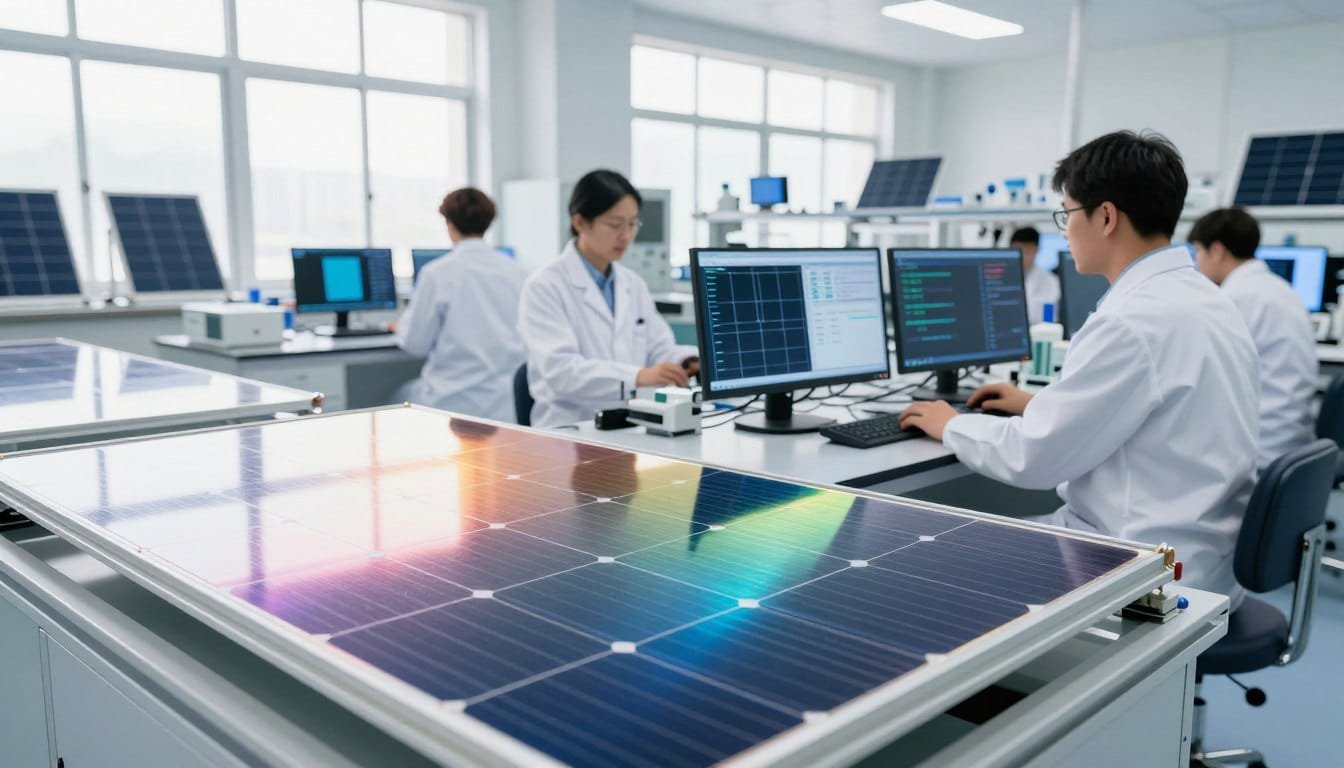
AI and Perovskite Solar Cells: Solving the Stability Challenge for Mass Production
Perovskite Solar Cells are transforming renewable energy—but they face a stability hurdle. Did you know that enough sunlight hits the Earth in just one hour to power the entire world for a year? We have tools to capture it, but traditional silicon panels are reaching their limits. Researchers are exploring new materials to better harness this energy.
Engineers are turning to next-generation photovoltaic technology. It’s lighter and cheaper than traditional hardware. These new layers can squeeze more power from sunlight than older models. They promise a flexible future for green energy in the UK.
The problem is these components fall apart quickly when exposed to oxygen and heat. They degrade in real-world conditions, making large-scale production hard. Without better durability, the technology can’t grow.
Breakthroughs show adding taurine creates a chemical shield to boost lifespan. Advanced computational modelling is helping scientists overcome these challenges. Soon, we can expect more stable hardware thanks to these digital tools.
Table of Contents
The Fragility of Perovskite Photovoltaic Cells in Industrial Applications
Perovskite solar cells are promising but face a big hurdle: their fragility. They are known for high efficiency and low cost potential. But they degrade easily under industrial conditions, making them hard to use widely.
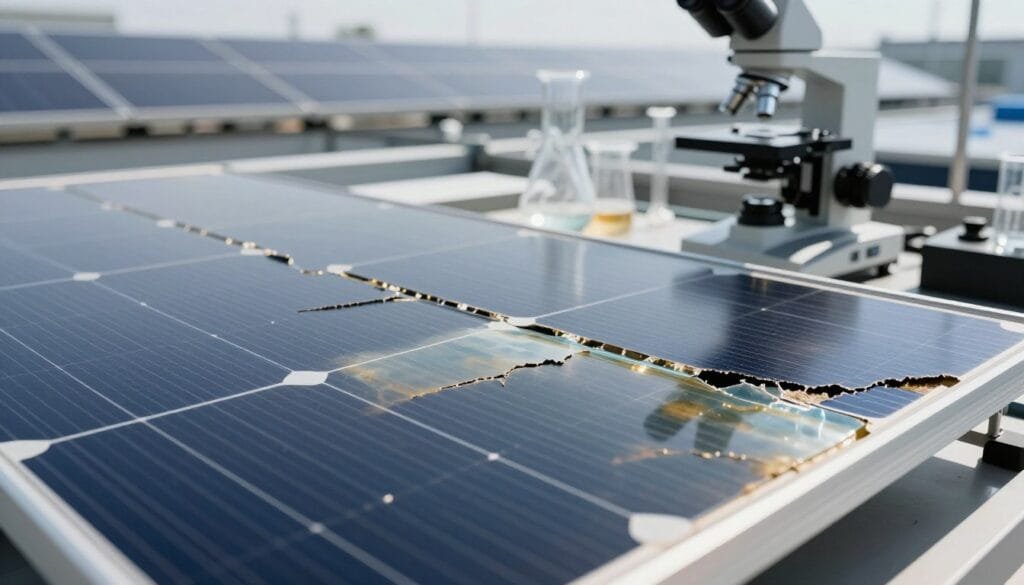
Strong light causes perovskite solar cells to break down. This happens when energetic electrons react with oxygen, creating harmful radicals. These radicals damage the crystal structure, reducing performance quickly.
Understanding the Degradation Mechanisms
To make perovskite photovoltaic cells more stable, we need to know how they degrade. Studies show that moisture, oxygen, and heat are the main culprits. These factors break down the crystal structure, hurting performance.
Understanding these mechanisms is key to finding ways to stop degradation. We must study the chemical and physical changes in perovskite materials under different conditions.
| Degradation Factor | Effect on Perovskite Solar Cells | Mitigation Strategy |
|---|---|---|
| Moisture | Hydrolysis of perovskite material | Encapsulation techniques |
| Oxygen | Formation of oxygen-based radicals | Use of oxygen barrier layers |
| Heat | Thermal decomposition | Improving thermal stability through material engineering |
The Gap Between Laboratory Success and Commercial Viability
Perovskite solar cells work well in labs but struggle in real-world use. Machine learning for photovoltaics can help bridge this gap. It predicts and improves performance under different conditions.
Machine learning helps find the most important factors for degradation. It also suggests ways to make perovskite photovoltaic cells more stable. This speeds up the development of better, more durable cells.
Leveraging Machine Learning for Photovoltaics and Material Discovery
You are on the cusp of a breakthrough in solar energy as machine learning transforms material discovery. The stability of perovskite solar cells is crucial for their industrial application. Researchers are now turning to artificial intelligence (AI) and machine learning to accelerate the discovery of new materials and the optimization of their properties.
Predictive Modelling for Chemical Composition
Predictive modelling plays a vital role in determining the chemical composition of perovskite photovoltaic cells. Machine learning algorithms help predict the stability and efficiency of various chemical compositions. This saves time and reduces costs compared to trial-and-error methods.
High-Throughput Screening of Additive Engineering
Machine learning is making a significant impact in high-throughput screening. It rapidly tests various additives and their effects on perovskite photovoltaic cells. This helps identify the most promising candidates for enhancing stability and efficiency.
Identifying Optimal Stabilising Agents
The identification of optimal stabilizing agents is critical for improving the longevity of perovskite photovoltaic cells. Machine learning models can analyze vast datasets to pinpoint the most effective additives and their optimal concentrations.
Reducing Experimental Iteration Cycles
By leveraging machine learning, you can significantly reduce the number of experimental iteration cycles. This is achieved through predictive modelling and high-throughput screening. Together, they enable a more efficient optimization process.
The use of machine learning in photovoltaics is not just about improving existing materials but also about discovering new ones. For instance, researchers have explored the use of antioxidant-inspired molecules to enhance the resistance of perovskites to sunlight.
You can see the potential of AI in material discovery through its ability to analyse complex data sets and predict outcomes. This is particularly useful in the context of perovskite photovoltaic cells, where stability is a major concern.
The table below illustrates how different additives can impact the stability of perovskite photovoltaic cells.
| Additive | Concentration | Stability Enhancement |
|---|---|---|
| Antioxidant A | 0.5% | 20% |
| Antioxidant B | 1.0% | 30% |
| Taurine | 0.8% | 25% |

Case Study: Autonomous Discovery via Self-Driving Laboratories
Recent breakthroughs in self-driving laboratories have opened new avenues for the rapid optimization of perovskite solar cells. These labs are changing the game by using AI, robotics, and high-throughput screening.
The Architecture of a Self-Driving Laboratory
Self-driving laboratories (SDLs) are a big step forward in how we do experiments. Think of SDLs as advanced robotic systems that can run experiments on their own. They make decisions based on data they collect in real time.
An SDL has a few key parts:
- Robotic systems for handling samples and performing experiments.
- Advanced sensors for real-time data acquisition.
- AI algorithms for data analysis and decision-making.
Real-Time Data Acquisition and Feedback Loops
SDLs can get data in real-time and change experiments as needed. This is key for improving perovskite photovoltaic cells. Even small changes can make a big difference in how well they work.
A typical feedback loop in an SDL involves:
- Experiment execution.
- Real-time data collection.
- Data analysis using AI algorithms.
- Adjustment of experimental parameters for subsequent experiments.
Overcoming Environmental Sensitivity Through AI Optimisation
Perovskite solar cells are very sensitive to things like moisture and heat. AI in SDLs helps deal with these issues.
Analysing Moisture and Thermal Stress Responses
Researchers use SDLs to study how different conditions affect perovskite photovoltaic cells. For example, they might look at how different humidity and temperature levels impact stability.
| Condition | Stability Metric | Response |
|---|---|---|
| High Humidity | Efficiency Loss | -15% |
| Thermal Stress | Power Output | -20% |
| Controlled Env. | Stability Gain | +10% |
A recent study showed how AI helps with the environmental sensitivity of perovskite solar cells. It was published on the cover of a top international energy journal.
“The integration of AI with experimental techniques has been pivotal in overcoming the challenges associated with the environmental sensitivity of perovskite solar cells.”
Using SDLs, we can find the best ways to make perovskite solar cells more stable and efficient.
Scaling Breakthroughs for UK Manufacturing Standards
Scaling breakthroughs are key for making perovskite solar cells work in the UK. You’re about to see how new discoveries are helping this process.
Going from lab success to industrial scalability is tough. A big challenge is making large modules without losing efficiency.
Transitioning from Small-Scale Cells to Large-Area Modules
Researchers have made big steps in this area. They’ve improved the electron transport layer. For example, a team found the right viscosity by changing the tin oxide (SnO₂) solution’s acidity.
This change helped them create modules with controlled defects. It’s a big step towards making large modules.
Integrating AI Insights into Industrial Scaling Processes
Artificial intelligence (AI) is key in making manufacturing better. It uses machine learning to predict the best chemical mix. This helps make solar cells more efficient faster.
AI helps make industrial scaling processes more efficient and cheaper. This is good for making perovskite solar cells.
Ensuring Long-Term Reliability for Renewable Energy Grids
For perovskite solar cells to work in renewable energy grids, they need to last long. It’s important to develop ways to control defects and improve making them.
By making perovskite solar cells reliable, we can use them in renewable energy grids. This helps make our future more sustainable.
Conclusion
Perovskite solar cells are a big hope for renewable energy, but they face a big challenge: stability. Thanks to understanding how they degrade and using machine learning, we’re making good progress. This helps make perovskite solar cells more stable.
Self-driving labs are speeding up research. They let us get data and feedback right away. This makes improving perovskite solar cells faster. As we make more, using AI in production is key.
Nature also gives us ideas for better solar panels. For example, molecules that protect sea creatures from stress could help solar panels last longer. With these new ideas, we’re getting closer to better, more stable solar cells for our energy needs.
The path to making lots of perovskite solar cells is tough, but AI is helping. As we keep improving, these solar cells could play a big part in our energy future.