
Nature’s Blueprint: How Bio-Inspired Innovation is Revolutionising Solar Energy
Have you ever stood in a quiet British woodland and marvelled at how leaves capture light so effortlessly? It is a gentle reminder that nature is the ultimate engineer, perfecting its craft over millions of years. You might find it fascinating that these green canopies hold the secrets to our future power.
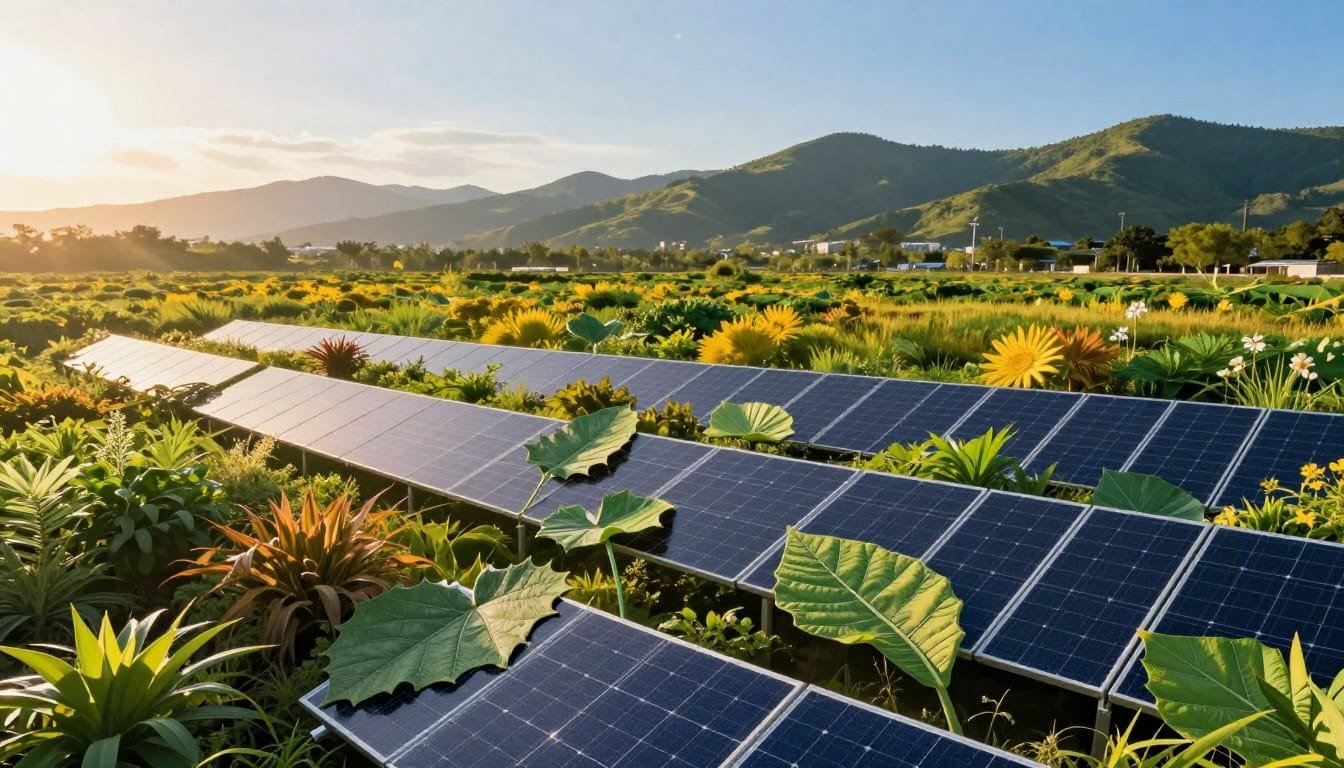
Today, scientists are turning to these natural wonders to develop bio-inspired solar solutions. By studying the way petals and leaves organise themselves, we can create panels that are far more effective than old designs. This approach allows us to mimic the incredible efficiency found in your own back garden.
Embracing these designs helps us build a world that works with the environment rather than against it. This shift marks a revolutionary moment for sustainability, promising a cleaner and more efficient energy landscape for everyone. We are finally learning to use the wisdom of the earth to power our modern lives.
Table of Contents
The Bio-Inspired Solar Revolution Transforming Renewable Energy
The use of biomimicry in energy is changing the solar industry. Scientists and engineers are creating new solar technologies. These technologies aim to increase energy output and lower costs.
What Makes Bio-Inspired Solar Different from Traditional Photovoltaics
Bio-inspired solar technologies are different from traditional ones. They use nature’s efficient designs to capture and convert light. This is unlike traditional solar panels, which are made using human engineering.
These bio-inspired panels mimic the light-harvesting of photosynthesis. This means they can capture a wider range of light and work better in different conditions.
- Bio-inspired solar panels can capture a wider spectrum of light.
- They can adapt to varying light conditions, improving efficiency.
- Nature-inspired designs can lead to more durable and sustainable solar panels.
A leading researcher said, “Biomimicry offers a promising pathway to overcoming the limitations of traditional solar technologies by leveraging millions of years of evolutionary innovation.”
“Biomimicry offers a promising pathway to overcoming the limitations of traditional solar technologies by leveraging millions of years of evolutionary innovation.”
Recent Industry Investments and Research Breakthroughs
Recently, there has been a lot of investment in bio-inspired solar research. This has led to breakthroughs in photovoltaic durability and efficiency. Companies and research institutions are working together to make these technologies more affordable and scalable.
Some key advancements include:
- The development of nanostructured surfaces that reduce reflection and increase light absorption.
- Innovations in material science that mimic the self-cleaning properties of certain leaves.
- Advances in solar cell architecture inspired by the structure of photosynthetic cells.
Key Players Driving Innovation in the UK and Globally
The UK is leading in bio-inspired solar innovation. Several key players are driving research and development. Around the world, companies and research institutions are also making big contributions.
| Organisation | Contribution |
|---|---|
| University of Cambridge | Research on bio-inspired nanostructures for solar cells |
| Oxford PV | Development of perovskite solar cells inspired by natural crystal formations |
| Imperial College London | Innovations in biomimetic solar panel design |
Photosynthesis Reimagined: How Leaf Structures Are Reshaping Solar Panels
Researchers are looking at leaves to make better solar panels. Leaves are good at catching sunlight. This can help solar energy work better.
Natural Light Harvesting Mechanisms in Plant Cells
Plant cells have chloroplasts, which are key for photosynthesis. These chloroplasts are shaped to grab more light. The way thylakoid membranes are set up in chloroplasts helps catch sunlight well. Scientists are using this idea for solar panels.
“The intricate structure of leaves and their ability to capture sunlight has inspired new approaches to solar energy harvesting.”
Leaves are arranged to get the most sunlight. This is helping scientists design better solar panels. They’re also looking at how to set up solar farms better.
Nanostructure Light Trapping Technologies in Commercial Development
New tech is being made to make solar panels work better. It uses tiny structures to catch more sunlight. This is like how leaves work.

One big idea is multi-layer absorption systems. These systems catch more sunlight, like chloroplasts do. They’re designed to work like plant cells.
| Feature | Natural Chloroplasts | Bio-Inspired Solar Panels |
|---|---|---|
| Light Absorption | Multi-layered thylakoid membranes | Multi-layer absorption systems |
| Efficiency | High efficiency in capturing sunlight | Potential for increased solar panel efficiency |
By copying how leaves work, scientists are improving solar energy. New tech like nanostructure light trapping and multi-layer systems are leading the way. This is changing solar energy for the better.
Butterfly Wings and Moth Eyes: The Anti-Reflective Revolution
Nature has given us a blueprint for new technology. The patterns on butterfly wings and moth eyes are leading a change in solar panels. You’re about to see how these natural wonders are changing solar energy.
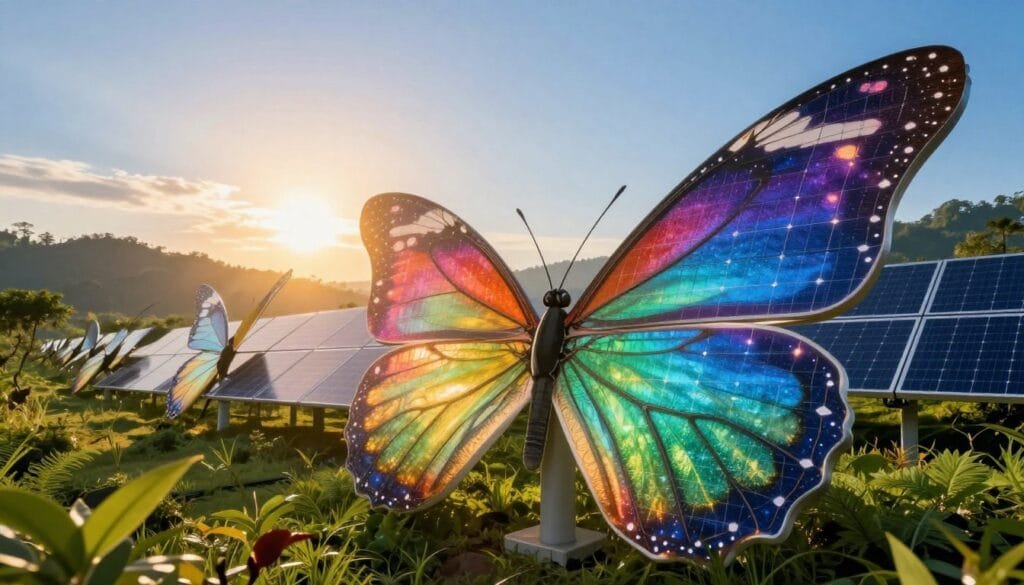
The tiny details on butterfly wings and moth eyes help them catch more light. Scientists are using this to make anti-reflective coatings for solar panels. They want to cut down on lost energy, making solar panels more efficient.
How Chiral Structures Eliminate Energy Loss
Scientists have found a way to use chiral structures to stop energy loss. These structures are not the same on both sides and have special optical properties. When used on solar panels, they help catch more light.
Chiral structures work by changing the way light moves from air to the solar panel. This change means less light is bounced back, and more is absorbed. So, solar panels can make more electricity from the same sunlight.
Laboratory Results Showing Efficiency Improvements
Lab tests have shown chiral structures can really boost solar panel efficiency. They’ve seen big drops in reflectance, leading to better energy conversion.
| Structure Type | Reflectance Reduction | Efficiency Improvement |
|---|---|---|
| Chiral Structure | 30% | 12% |
| Traditional Coating | 10% | 4% |
Manufacturing Challenges and Recent Solutions
But making solar panels with chiral structures is hard. It needs very precise nanostructure making, which is tricky and expensive.
But, new tech in nanotechnology and making things has helped. Now, companies are finding ways to make these structures cheaper. This could lead to more efficient solar energy.
Heliotropism Technology: Solar Panels That Follow the Sun
Heliotropism technology is inspired by nature’s sun-tracking ways. It’s changing how we use solar panels. This new method makes solar energy more effective and practical.
Nature’s Sun-Tracking Mechanisms in Sunflowers and Other Plants
Sunflowers and other plants move to follow the sun. This helps them get more sunlight, which boosts their growth. Heliotropism technology does the same for solar panels, making them more efficient.
Smart Tracking Systems Increasing Energy Capture by 40 Per Cent
Smart tracking systems, inspired by heliotropism, have shown great results. They can boost energy capture by up to 40 per cent. This means solar panels can produce more energy, making solar power a better choice.
Here’s a comparison of energy output between old solar panels and those with heliotropism technology:
| Technology | Energy Output (kWh) | Efficiency Gain |
|---|---|---|
| Traditional Solar Panels | 1000 | – |
| Heliotropism Technology | 1400 | 40% |
Cost-Benefit Analysis for UK Solar Installations
Starting with heliotropism technology costs more than old solar panels. But, the extra energy and savings on bills make up for it. In the UK, it’s a smart choice for solar installations.
The UK is moving towards renewable energy, and heliotropism technology is key. It helps us reach our sustainability goals. By using these bio-inspired solutions, we can make our future cleaner and greener.
Perovskite Solar Cells: Mimicking Natural Crystal Formations
Perovskite solar cells are a new hope for better solar energy. They take inspiration from nature’s crystals. This makes them more efficient at turning sunlight into electricity.
Advantages Over Traditional Silicon
Perovskite solar cells beat traditional silicon ones in many ways. Their structure means they can convert more sunlight into electricity. They also can be made flexible and semi-transparent, which opens up new uses.
Key benefits of perovskite solar cells include:
- Higher power conversion efficiency
- Flexibility in design and application
- Potential for semi-transparent cells
- Lower production costs compared to traditional silicon cells
Enhancing Durability Through Bio-Inspired Encapsulation
One big problem with perovskite solar cells is how long they last. Scientists are using nature’s tricks to make them last longer. This includes copying how plants protect themselves.
Self-Healing Materials Inspired by Plant Cell Walls
Self-healing materials are a new way to make solar cells last longer. They work like plant cell walls, fixing themselves when damaged. This means solar cells can keep working for a longer time.
Weather Resistance Technologies for British Climate Conditions
The British weather is tough on solar cells. Scientists are working on ways to make them weatherproof. This will help them stay efficient and working well, even in harsh weather.
| Technology | Advantages | Challenges |
|---|---|---|
| Perovskite Solar Cells | Higher efficiency, flexibility, semi-transparency | Durability, scalability |
| Bio-Inspired Encapsulation | Enhanced durability, self-healing properties | Cost, complexity of implementation |
| Weather Resistance Technologies | Improved resilience to environmental factors | Material compatibility, additional costs |
Sustainable Manufacturing: Biomimicry in Energy Production Processes
The solar industry is using biomimicry to make its manufacturing greener. By learning from nature, they’re finding new ways to be eco-friendly. These methods also cut costs and boost efficiency.
Low-Temperature Assembly Methods
Biological systems often work at low temperatures. This idea is being used in solar panel making. Traditional methods use high temperatures, wasting a lot of energy and harming the environment.
Low-temperature assembly methods are changing this. They use less energy and let in more materials. This makes solar panels better for the planet.
For example, bio-inspired adhesives are being made. They stick materials together at lower temperatures. This cuts down on energy use and opens up new material options for solar panels.
Reducing Carbon Footprints
Making solar panels has its own environmental cost. But biomimicry is helping to lower this. Companies are using bio-based materials and cutting down on waste.
| Manufacturing Aspect | Traditional Method | Bio-Inspired Method |
|---|---|---|
| Energy Consumption | High-temperature processes | Low-temperature assembly |
| Material Usage | Limited by high-temperature requirements | Wider range of materials usable |
| Waste Reduction | Significant waste generation | Minimised waste through optimised processes |
UK Companies Leading Green Initiatives
UK companies are leading the way in green solar manufacturing. They’re cutting down on waste and setting new standards.
Oxford PV is leading with perovskite solar cells. These could be more efficient and green than old silicon cells. Their work shows how biomimicry can make solar tech better.
As solar energy grows, green manufacturing is key. Biomimicry helps reduce carbon footprints and boosts efficiency. It’s a step towards a greener future.
Architectural Integration: Nature-Inspired Solar in Built Environments
Bio-inspired innovation is changing how we design buildings. It makes solar energy a part of building design. This not only looks good but also saves energy. Nature-inspired solar technologies are changing cities.
Tree Bark Textures and Organic Patterns in Urban Solar Design
Architects and designers often look to nature for ideas. Tree bark textures and patterns are now in urban solar design. These designs make solar panels and buildings look better and fit in better.
Using organic patterns in solar design also helps with building-integrated photovoltaics (BIPV). BIPV systems are part of buildings, making power and being structural. They look like natural parts of the building.
Building-Integrated Photovoltaic Systems Across the UK
The UK is leading in using BIPV systems. They are in homes and big buildings. BIPV systems save money, look good, and increase property value.
- Improved energy efficiency
- Enhanced architectural aesthetics
- Increased property value
- Reduced carbon footprint
Notable Projects: From the Eden Project to London’s Innovation Quarter
Many projects in the UK use nature-inspired solar. The Eden Project has solar panels that look like part of the building. London’s Innovation Quarter also uses BIPV systems, showing a new way to build sustainably.
Regulatory Support and Planning Guidelines for Bio-Inspired Installations
The UK supports bio-inspired solar with rules and guidelines. These help make sure renewable energy fits with local rules. Knowing these guidelines is key for a successful installation.
Using nature-inspired solar helps make buildings better for the environment. The UK is a leader in this area. The future for bio-inspired installations looks bright.
Conclusion
Bio-inspired solar technology is changing how we use renewable energy. Scientists and engineers are using nature’s designs to make solar energy better. This means we can capture and use more solar power.
The possibilities with bio-inspired solar are huge. We’re seeing solar panels shaped like leaves and coatings inspired by butterfly wings. These ideas make solar energy more efficient and help the environment.
More research and money are needed to keep improving solar energy. As the UK and the world use more bio-inspired solar, we’ll see big changes. These changes will help us use less carbon and make our energy cleaner.
Supporting bio-inspired solar technology means a greener future for all. Nature’s designs are leading the way in renewable energy. It’s thrilling to think about what’s next.