
The TOPCon Encapsulant Trap: Why “Safe” POE Can Cause 55% Power Loss
Imagine the pride when sleek panels go on your roof. You think you’ve made a green choice, but a hidden flaw might be wasting your money. It feels like a betrayal of the trust you put in green tech.
Recent studies have turned our understanding of protecting these cells upside down. We thought all POE was safe and all EVA was risky. But now, we know this is wrong and could harm your equipment.
Some mixes can cause a huge 55% power loss. While many thought EVA was the problem, some TOPCon solar encapsulants are actually more dangerous than we thought.
You deserve to know why “safe” materials might not be working for your energy system. Modern EPE options are often better and cheaper for long-term protection. Picking the right protection is key to keeping your efficiency high for years.
Table of Contents
1. Understanding the Critical Role of Encapsulants in TOPCon Technology
Encapsulants are key to the success of TOPCon solar technology. As solar tech advances, knowing about encapsulants and their effect on TOPCon solar cells is crucial.
1.1 What Makes TOPCon Solar Cells Different from Traditional PV Technology
TOPCon solar cells stand out from traditional PV tech. They have a special structure with a tunnel oxide passivated contact. This boosts their efficiency. They also use silver-aluminum front contacts, which are more reactive than pure silver.
1.2 Why Encapsulant Selection Determines Your System’s Longevity
Choosing the right encapsulant is vital. It protects TOPCon solar cells from damage caused by the environment and chemical reactions. This helps keep their performance high over time.
1.3 The Rising Adoption of Bifacial Dual-Glass TOPCon Modules
Bifacial dual-glass TOPCon modules are becoming more popular. They offer better efficiency and durability. But their sealed design can trap moisture and acids, which can harm the cells if the encapsulant is not chosen wisely.
| Module Type | Encapsulant Requirement | Performance Impact |
|---|---|---|
| Bifacial Dual-Glass TOPCon | Highly resistant to moisture and chemicals | Enhanced longevity and efficiency |
| Traditional PV | Standard encapsulant materials | Conventional performance and lifespan |
2. The Hidden Dangers of POE Encapsulants in TOPCon Solar Cells
The solar industry is moving towards TOPCon technology fast. It’s key to know the risks of POE encapsulants. These risks can affect how well and how long TOPCon solar cells work.
2.1 Magnesium-Induced Degradation: The 55% Power Loss Mechanism
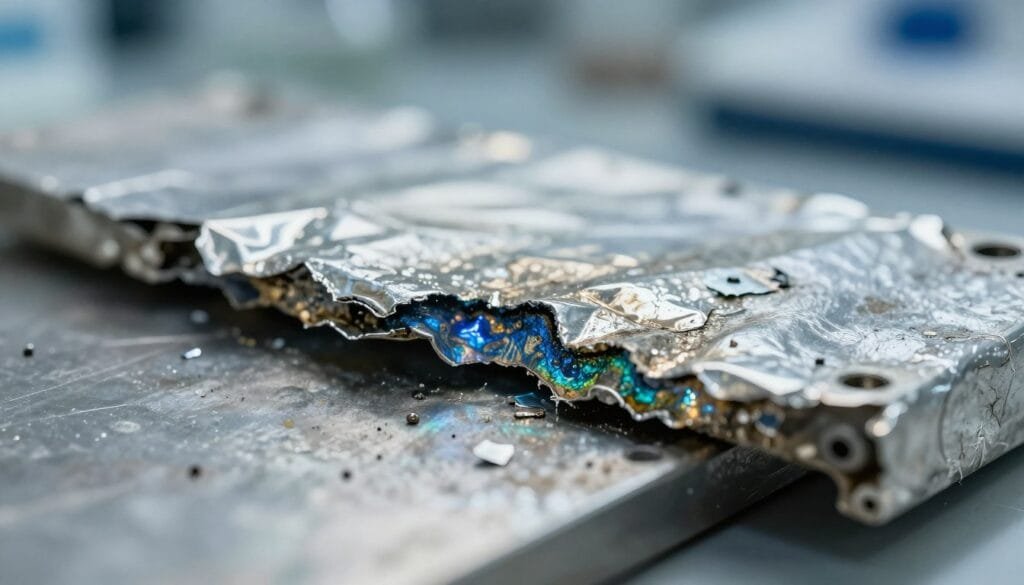
Researchers at the University of New South Wales tested three POE types on TOPCon cells. They found big differences in how well the cells performed. One POE, POE-C, caused a huge 55% power loss. Another, POE-B, had only a 6% loss.
This shows how important the right POE is. The UV absorber package in POE matters a lot. It helps avoid damage from magnesium.
2.2 Silver-Aluminium Contact Corrosion in TOPCon Structures
POE encapsulants can also cause silver-aluminum contact corrosion. This corrosion can harm the TOPCon structure. It might make the solar cells work less well over time.
2.3 Open-Circuit Voltage Loss and Performance Degradation
POE encapsulants can also lead to open-circuit voltage loss. This loss can make the solar cells perform worse. The type of POE and how it interacts with the cell matter a lot.
2.4 How POE Encapsulant Additive Recipes Create Vulnerability
The mix of POE encapsulants, including additive recipes, affects their quality. Different additives can help or hurt the cells’ performance.
Here’s a table comparing different POE types and their effects on TOPCon cells:
| POE Formulation | Power Loss (%) | UV Absorber Package |
|---|---|---|
| POE-A | 10 | Standard |
| POE-B | 6 | Advanced |
| POE-C | 55 | Basic |
Knowing these details is key to picking the best POE for TOPCon solar cells. This ensures they work well and last long.
3. Choosing the Right TOPCon Solar Encapsulants: EPE vs POE
Choosing the right encapsulants for TOPCon solar cells is key. EPE and POE have different impacts on your system’s performance. As TOPCon technology grows, knowing these materials well is vital for your solar’s long life and efficiency.
3.1 Polyolefin Elastomer (POE) Encapsulants
POE encapsulants are popular for their strong moisture barrier. POE blocks moisture very well, better than EVA. This makes it a top choice for many solar makers.
3.1.1 Standard POE Formulations and Their Applications
Standard POE is used in many solar projects, including TOPCon modules. It sticks well to glass and solar cells, ensuring good performance over time.
3.1.2 Performance Limitations Under Damp-Heat Conditions
POE has some downsides in damp heat. High temperatures and humidity can cause it to degrade. This might hurt the module’s performance.
3.1.3 Long-Term Reliability Concerns for TOPCon Cells
POE’s long-term reliability in TOPCon cells is still being studied. While it performs well at first, its stability over time is crucial for TOPCon use.
3.2 Ethylene Propylene Elastomer (EPE) Encapsulants
EPE is a new option for TOPCon solar cells. It offers good moisture protection, balancing between POE and EVA.
3.2.1 Superior Chemical Stability for TOPCon Applications
EPE’s superior chemical stability is a big plus for TOPCon. It keeps its protective qualities over time.
3.2.2 Enhanced Protection for Bifacial Dual-Glass TOPCon Modules
EPE gives extra protection for bifacial dual-glass TOPCon modules. Its chemical stability keeps it strong against environmental stress.
3.2.3 Cost-Benefit Analysis for UK Solar Installations
For UK solar projects, consider EPE’s costs and benefits. EPE’s better performance and reliability must be weighed against its cost. Think about long-term energy yield and module durability.
In summary, picking between EPE and POE for TOPCon solar cells involves many factors. Know each material’s strengths and weaknesses. This helps make a smart choice for your solar investment.
4. What Damp-Heat Solar Testing Reveals About Encapsulant Performance
It’s key to know how encapsulants do in damp-heat tests when picking materials for TOPCon solar modules. Damp-heat tests mimic the long-term effects of high humidity and heat on solar panels.
4.1 IEC 61215 Damp-Heat Testing Standards and Protocols
The IEC 61215 standard is a key test for solar module durability, including damp-heat resistance. This test puts modules in 85°C and 85% humidity for 1,000 hours. But some makers now test for 2,000 hours or more to find hidden issues.
4.2 Comparative Test Results: POE vs EPE Performance Data
Tests show big differences between POE and EPE encapsulants in damp heat. EPE keeps the module’s electrical and structural health better over time.
| Encapsulant Type | Initial Efficiency | Efficiency After 1,000 Hours | Efficiency After 2,000 Hours |
|---|---|---|---|
| POE | 20.5% | 19.2% | 17.5% |
| EPE | 20.5% | 20.1% | 19.8% |
4.3 Real-World Implications for Your Solar Investment
Damp-heat test results are vital for your solar investment’s long-term performance. Picking an encapsulant that does well in damp heat can help avoid open-circuit voltage loss in TOPCon modules, safeguarding your investment.
4.4 Interpreting Test Results for UK Climate Conditions
For UK solar installations, it’s important to understand how damp-heat test results apply to local weather. The UK’s climate is milder than the test conditions, but humidity and temperature changes can still affect module performance over time.
By looking closely at damp-heat test results and your location’s climate, you can choose the best encapsulants for your TOPCon solar modules.
5. Conclusion
Choosing the right material for TOPCon solar encapsulants is key. It ensures your solar modules last long and work well. The old idea that “POE equals safe” and “EVA equals risky” is outdated. What really matters is the quality of the encapsulant.
Make sure to pick certified POE with HALS UV stabilizers. Check the test data to ensure your TOPCon system is reliable. The right encapsulant can greatly lower the chance of power loss and performance drop. This means a better return on your solar investment.
Knowing how important encapsulants are in TOPCon technology helps you make better choices. This way, you can improve your solar module’s performance and lifespan. TOPCon solar encapsulants are crucial for your solar system’s efficiency and durability.